Join our membership

Statement on World Day of Social Justice 2025

On this Social Justice Day, we stand committed to the values of sustainable, inclusive, and democratic education. An education free from discrimination and accessible to all. Yet, across the world, this fundamental right is under attack.

We are deeply concerned about the recent trends in the United States, where the Trump administration is deliberately eroding rights of racialised, LGBTQ+, and immigrant students: actions that threaten the very foundation of equitable education. Moreover, the environmental policies that accompany these changes exacerbate inequalities, as access to education and to a healthy living and learning environment is increasingly tied to political agendas.

We are extremely concerned about the devastating rippling effect of the US Presidency’s actions all around the world. The entanglement of education with regressive policies deepens inequalities, as access to quality and inclusive learning increasingly becomes a privilege rather than a right.

The US is not a stand-alone situation. If we look around the globe, the situation is alarming: in Afghanistan the Taliban’s regime has erased girls from classrooms, depriving an entire generation of their right to learn. Meanwhile, in Gaza the devastating war has led to the destruction of schools and restrictions on movement that make access to education a daily struggle.

And in Europe? The rise of the far right threatens educational freedom and social cohesion. In many regions, underfunded public education, growing privatization, and nationalist curricula serve to exclude rather than empower, leaving young people without the critical tools to shape their futures.
We refuse to accept an education system dictated by fear, exclusion, and economic interests.

Instead, we will continue to find avenues for getting together and standing for children and young people’s right to a chosen future, not one they’ve been subjected to. For their right to an education that is geared towards socio-environmental justice, in which democratic principles are lived out and every person can actively participate in the decisions that affect their lives.
More publications

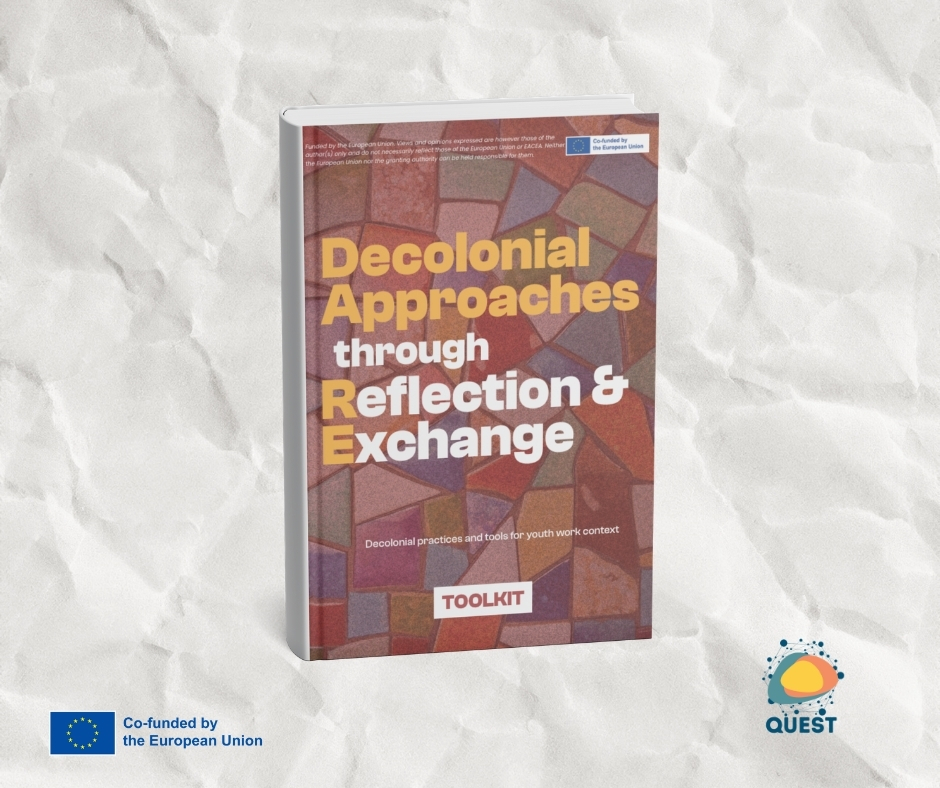
Decolonial Approaches through Reflection & Exchange Toolkit

This toolkit is the result of a 5-day training bringing together youth workers from Belgium, Greece, Italy and Spain, learning and putting into practice decolonial and anti-oppressive approaches Here, you will find clear information and tools to learn about colonial legacies, whiteness and systemic inequalities, and how to put decolonial and anti-oppressive approaches into practice through step-by-step instructions, tips and feedback from the youth workers who already took the training.

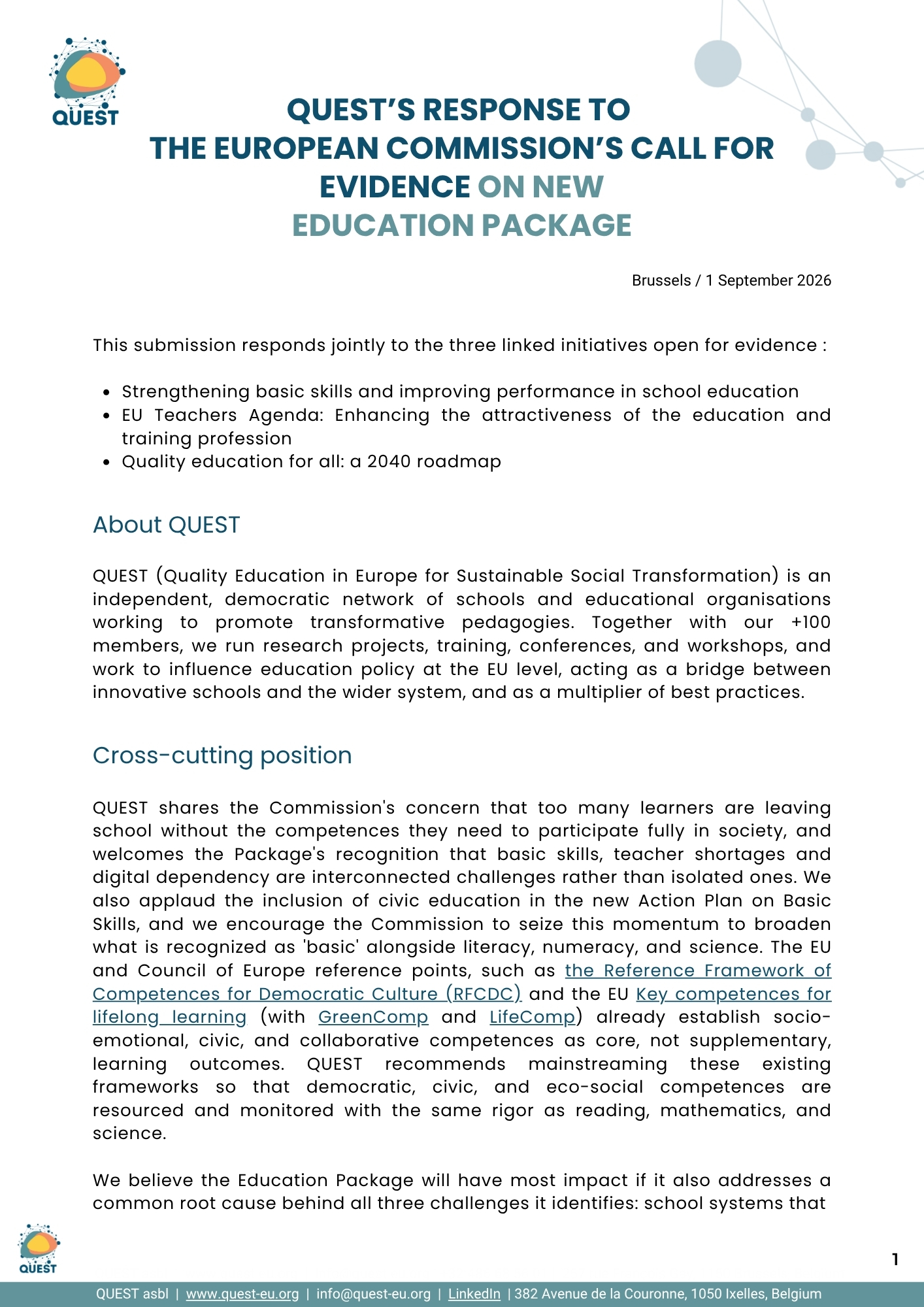
QUEST’S Response to the European Commission’s Call for Evidence on New Education Package

This submission responds jointly to the three linked initiatives open for evidence : - Strengthening basic skills and improving performance in school education - EU Teachers Agenda: Enhancing the attractiveness of the education and training profession - Quality education for all: a 2040 roadmap

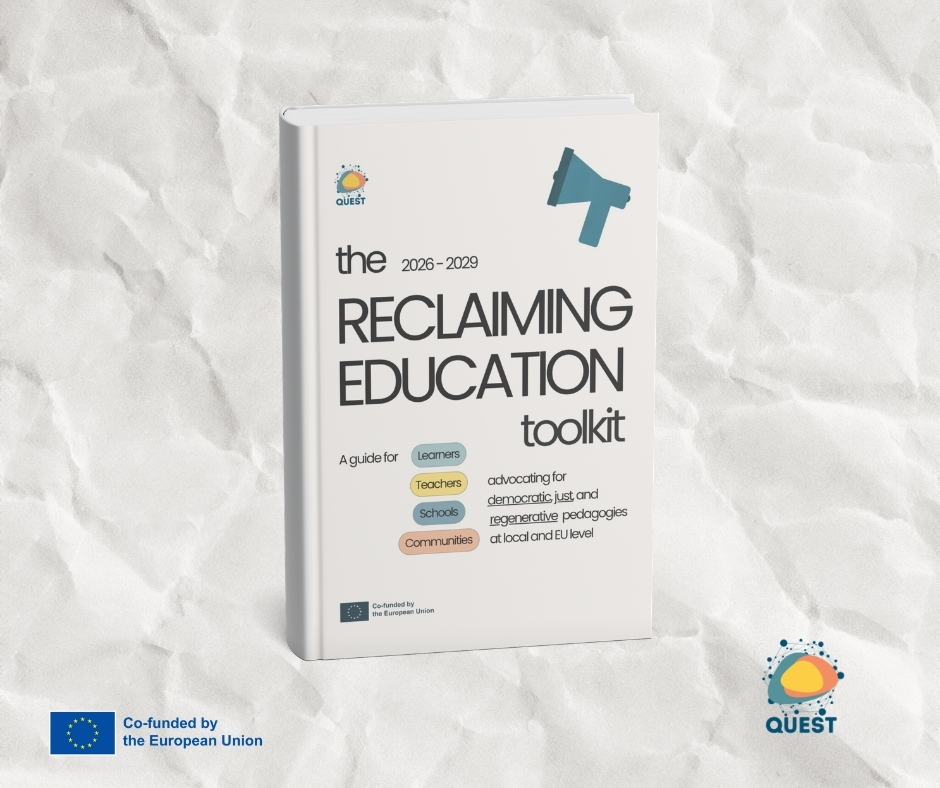
The Reclaiming Education Toolkit

This toolkit wants to demystify EU advocacy and help you navigate local and European decision-making, so that your school / organisation can raise their concerns and visions for education at different levels.

Cala Wioska School

Cala Wioska School

Biography coming soon.

Creating a Safe, Inclusive and Supportive Classroom

Sehlim Charles

Biography coming soon.

Young Children’s Voices in Educational Decision-Making: Power and Participation in Disadvantaged Preschool Classrooms

Duygu Yalman Polatlar

Duygu Yalman Polatlar is an Assistant Professor at Fatih Sultan Mehmet Vakıf University, Türkiye. Her research focuses on early childhood education, children’s literature, children’s rights, and children’s participation.

Alperen Avcı

Alperen Avcı is a lecturer at Muş Alparslan University, Türkiye, and a PhD candidate in Preschool Education at Fatih Sultan Mehmet Vakıf University.

Rights-based Participation of Children with Special Educational Needs in Educational Decision-Making

Lenka Mazáková

Lenka Mazakova is a co-founder of the Slobodna skola. She specializes in inclusive educational practices for students with diverse needs and behavioural challenges in democratic school environments.

From Participation to Practice: How Evidence-Based Wellbeing and Equity-Focused Leadership Can Shift Power Towards Children’s Voices in Education

Geetika Goyal

Biography coming soon.

Jayne Carter

Biography coming soon.

Reimagining Educational Research Through Children’s Participation: Insights from Transdisciplinary and Participatory Approaches

Sarah Zerika

Sarah Zerika holds a PhD in Educational Sciences and is a Substitute Research and Teaching Fellow at the University of Geneva’s Centre for Children’s Rights Studies. Her research focuses on children’s rights and participation in education, school climate, transdisciplinary approaches, and the ethics of research involving children.

Johanna Zelck

Johanna Zelck is a research and teaching assistant at the Martin-Luther-University Halle-Wittenberg. Her doctoral research focuses on children’s interpretation and negotiations of the generational order and adultism.

Maude Louviot

Biography coming soon.

From Consultation to Co-Creation: Child Leadership in Practice in Bosnia & Herzegovina and Serbia

Nejira Pasic

Nejira Pašić is the Children’s Rights Project Lead for Southeast Europe at the Global Campus of Human Rights, where she leads children’s rights mainstreaming and programming, including the Child Leadership Team and Youth Advisory Group. She is also a Lecturer at the Sarajevo School of Science and Technology, teaching research methods, public policy and human rights.