






This November, QUEST participated in an international press release centered around World Children’s Day. The action was a call to the United Nations’ Committee on the Rights of the Child to clarify that “compulsory education” means a guarantee of universal access to education and does not mean forcing a child to attend school.
The Universal Declaration of Human Rights in 1948 was the first international recognition of Education as a Right, and it expressed the importance of this Right in Article 26 as “elementary education shall be compulsory”. While it has become common practice to translate and paraphrase this as ‘compulsory school attendance for children’, this is not in line with the original intent of the wording, says IDEC.
The minutes of the meetings of the UDHR drafting committee chaired by Eleanor Roosevelt record extensive discussions about this word and clearly show that nobody on the drafting committee at any point meant the word ‘compulsory’ to be interpreted as coercion of the child. Instead, as explained by General Comment No.11 of the Committee on Economic, Social and Cultural Rights (CESCR) “The element of compulsion serves to highlight the fact that neither parents, nor guardians, nor the State are entitled to treat as optional the decision as to whether the child should have access to primary education.
The call for clarification, as initiated by IDEC (International Democratic Education Conference) seeks to bring clarity to the fact that ‘compulsory’ is not synonymous with ‘coercion’. As such, the resolution insists that the principle of the ‘best interests of the child’ must be fully respected, rather than being compromised for political and administrative expediency.
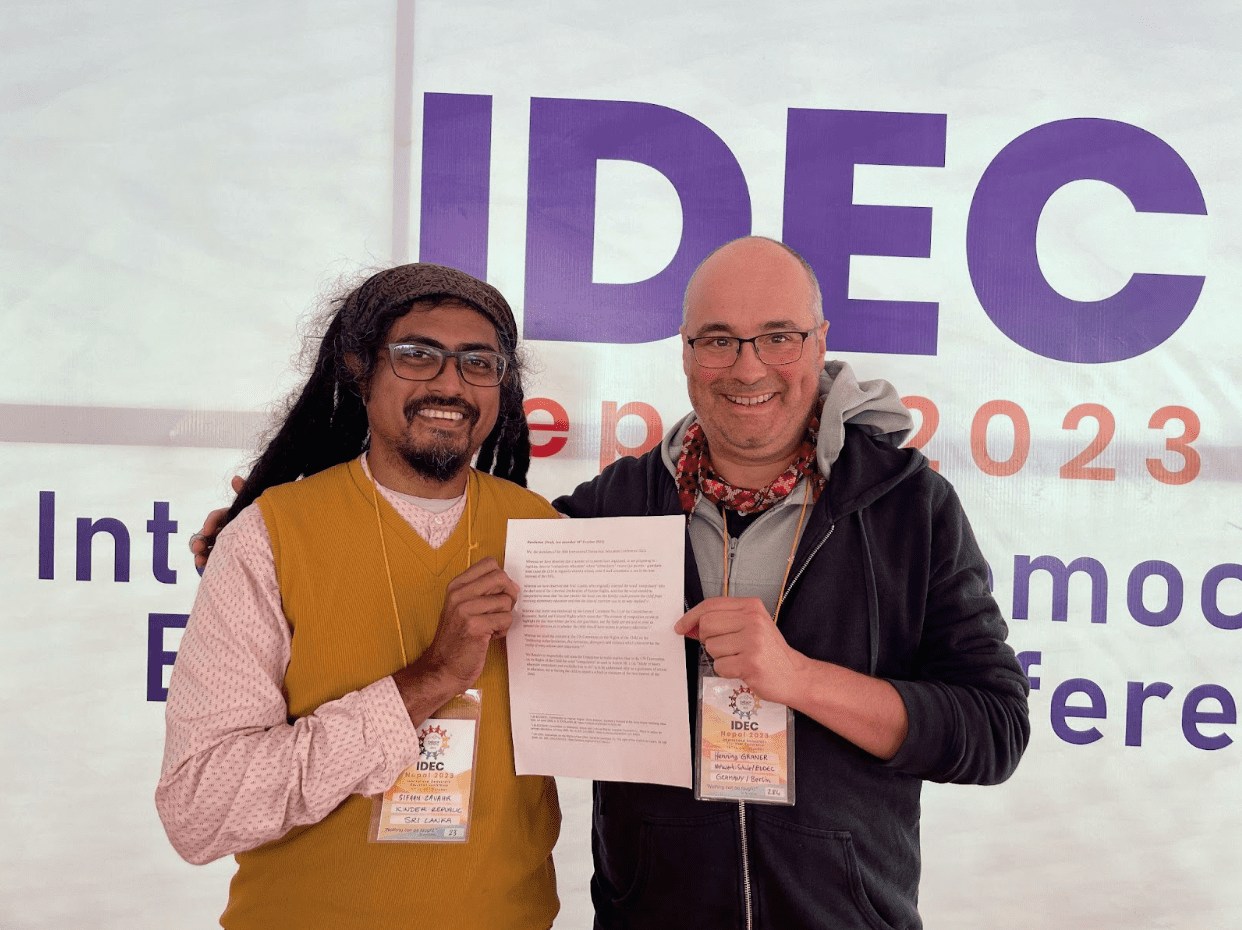
The IDEC Resolution 2023 was collaboratively drafted by international democratic education defenders led by Richard Fransham (Canada), Sifaan Zavahir (Sri Lanka), Henning Graner (Germany) and Je’anna Clements (South Africa) with input from a number of other participants from around the world. The International Democratic Education Conference adopted this resolution in Nepal during the IDEC General Meeting on Thursday 19th October 2023. It is being sent to the UN Committee on the Rights of the Child in commemoration of the anniversary of the United Nations’ Convention on the Rights of the Child on 20th November 2023.