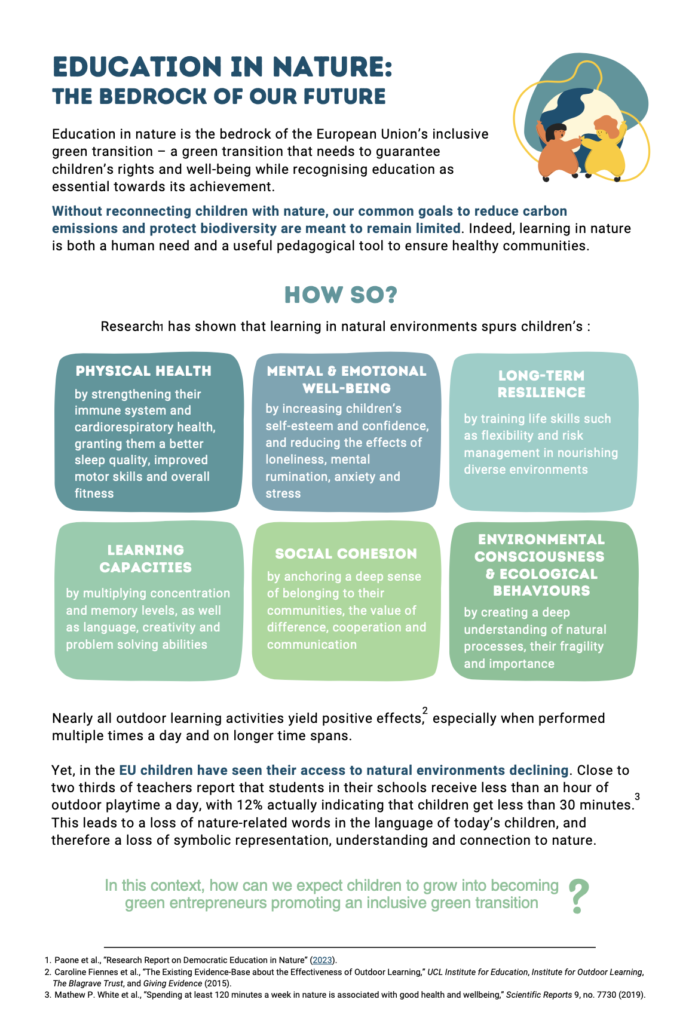


Education in nature is the bedrock of the European Union’s inclusive green transition – a green transition that needs to guarantee children’s rights and well-being while recognising education as essential towards its achievement.
Without reconnecting children with nature, our common goals to reduce carbon emissions and protect biodiversity are meant to remain limited. Indeed, learning in nature is both a human need and a useful pedagogical tool to ensure healthy communities.
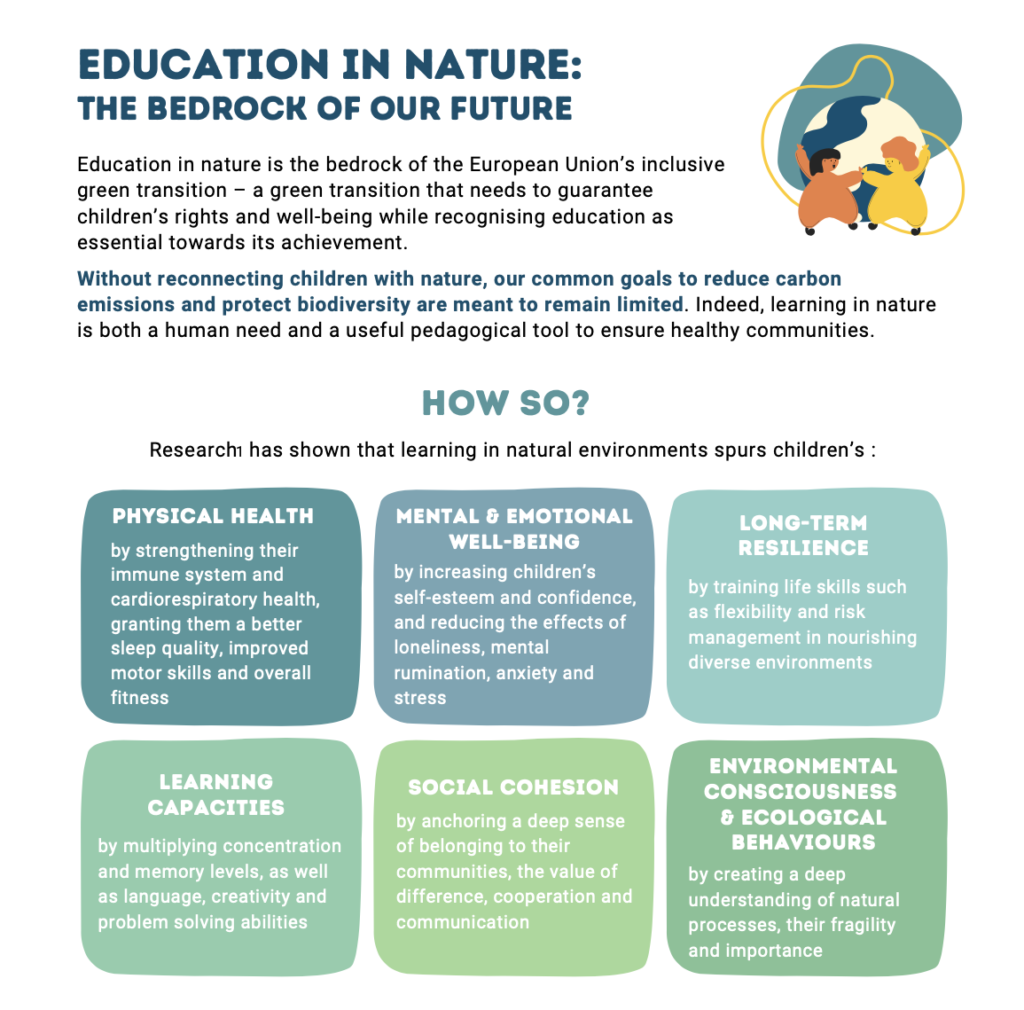
HOW SO?
PHYSICAL HEALTH
by strengthening their immune system and cardiorespiratory health, granting them a better sleep quality, improved motor skills and overall fitness
MENTAL & EMOTIONAL WELL-BEING
by increasing children’s self-esteem and confidence, and reducing the effects of loneliness, mental rumination, anxiety and stress
LONG-TERM RESILIENCE
by training life skills such as flexibility and risk management in nourishing diverse environments
LEARNING CAPACITIES
by multiplying concentration and memory levels, as well as language, creativity and problem solving abilities
SOCIAL COHESION
by anchoring a deep sense of belonging to their communities, the value of difference, cooperation and communication
ENVIRONMENTAL CONSCIOUSNESS & ECOLOGICAL BEHAVIOURS
by creating a deep understanding of natural processes, their fragility and importance
Nearly all outdoor learning activities yield positive effects, especially when performed multiple times a day and on longer time spans.
Yet, in the EU children have seen their access to natural environments declining. Close to two thirds of teachers report that students in their schools receive less than an hour of outdoor playtime a day, with 12% actually indicating that children get less than 30 minutes. This leads to a loss of nature-related words in the language of today’s children, and therefore a loss of symbolic representation, understanding and connection to nature.
In this context, how can we expect children to grow into becoming green entrepreneurs promoting an inclusive green transition?
To answer this question, QUEST launched the Democratic Education in Nature project: a research project seeking to establish a common definition for a cutting-edge pedagogy called Democratic education in nature.
What is Democratic education in nature?
Democratic education in nature aims to bridge education in nature with democratic education. On the one hand, education in nature encompasses various approaches such as outdoor learning, forest schooling and environmental education. Since the 90’s this pedagogy has slowly reached independent schools embracing the democratic education philosophy. Democratic education, on the other hand, sees children as capable actors with the right to get involved in matters that affect their own lives, including in their learning pathways and wider communities. Teachers and learners, all together, form a community of equals in which children directly contribute to school governance and decision-making processes.
Democratic education follows two key principles :
Children’s right to self-determination
Children make primary decisions regarding their learning experiences, emphasising autonomy.
Democratic community processes
Children learn to articulate their views, collaborate and negotiate agreements through democratic community processes in which each participant has an equal voice and vote.
Democratic education in nature therefore adopts the same principles with a deeper connection to nature. Self-directed learning in nature, for instance, triggered by children’s internal motivation to learn, provokes a deeper emotional connection to nature. Democratic community processes, on the other hand, offer tools to federate community identity, cooperation and collective creativity in natural environments.
What can we do to promote democratic education in nature?
- Recognise democratic education and education in nature through national and EU supportive legal frameworks
- Fund trainings and exchanges of good practices on the democratic education in nature pedagogy in the EU
- Provide flexibility in curriculums to allow teachers to reserve spaces for outdoor learning and dedicate time to subjects chosen by students
- Reduce teachers’ overload to free up time for getting training on cutting-edge pedagogies like democratic education in nature