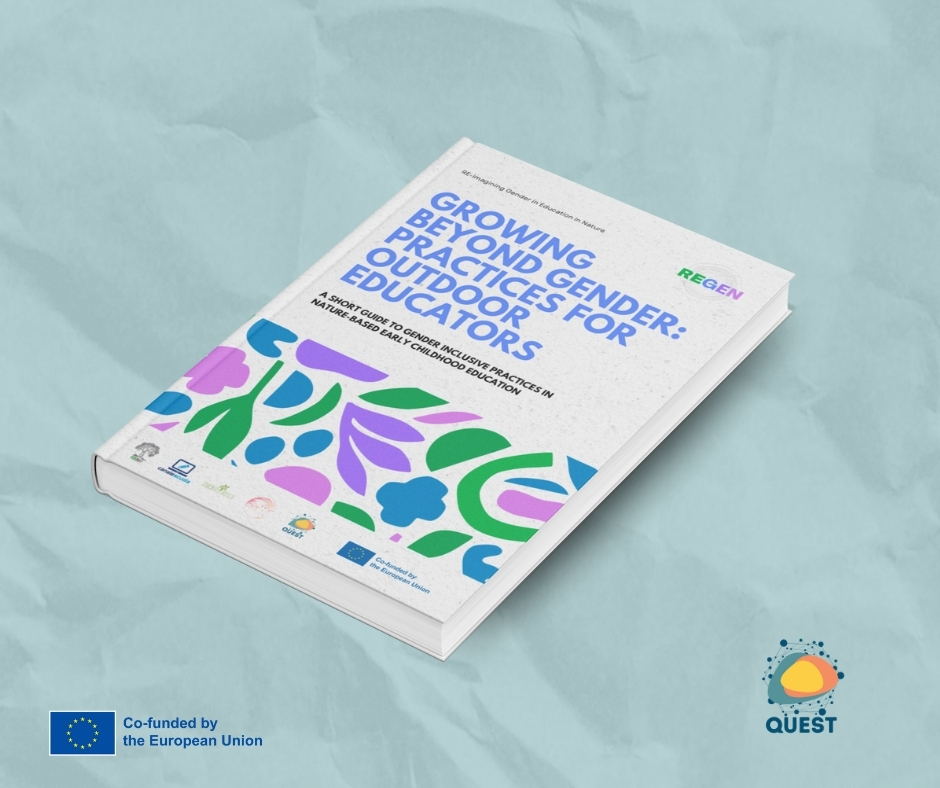
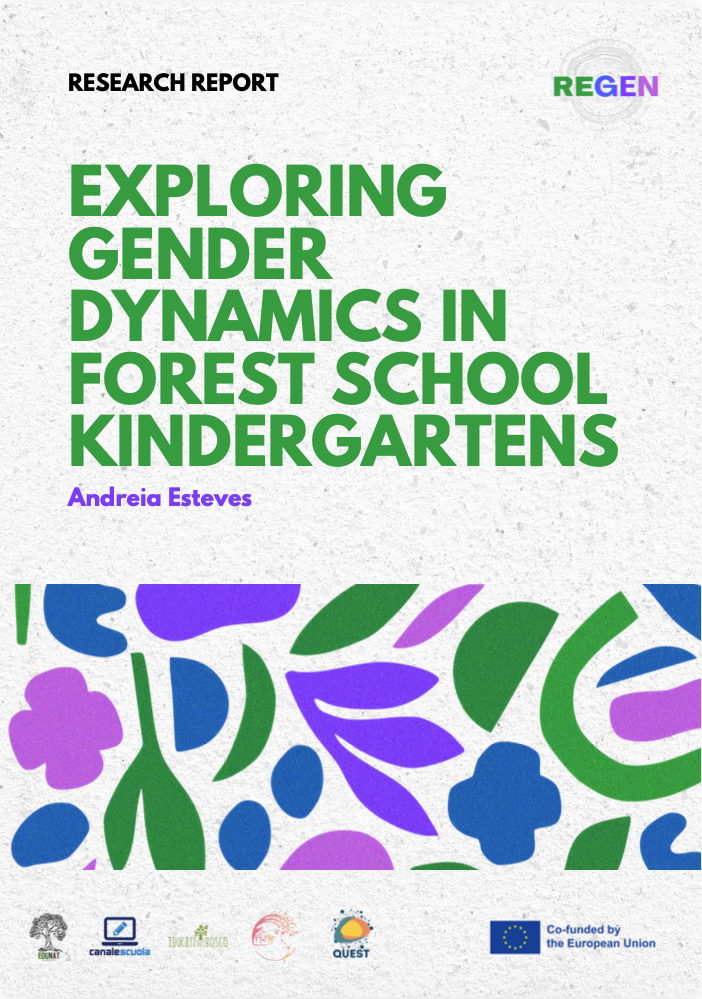
This report explores how gender dynamics manifest in children’s play and interactions within outdoor kindergarten environments that follow the Forest School pedagogy. Developed under the Erasmus+ project REGEN – RE-imagining Gender in Education in Nature, it combines perspectives from gender studies and outdoor education to examine how nature-based learning can contribute to more equitable educational practices.
The research was conducted in collaboration with three Forest Schools in Belgium, Italy, and Spain, together with QUEST, an independent European network advocating for children’s rights in education. It draws on several research methods: a literature review analysing existing findings within the national contexts of Belgium, Italy, and Spain; field observations in the three partner schools; recorded interviews with educators; and an online survey open to practitioners in nature-based education projects both in and outside Europe.
In addressing its main research question — How do gender dynamics manifest in children’s play and interactions in outdoor kindergarten environments using the Forest School pedagogy? — this study provides an overview of Forest School pedagogy and gender-based education in Europe, exploring both the challenges and opportunities of advancing gender equity in outdoor early education.
Funded by the European Union. Views and opinions expressed are however those of the author(s) only and do not necessarily reflect those of the European Union or the European Education and Culture Executive Agency (EACEA). Neither the European Union nor EACEA can be held responsible for them.