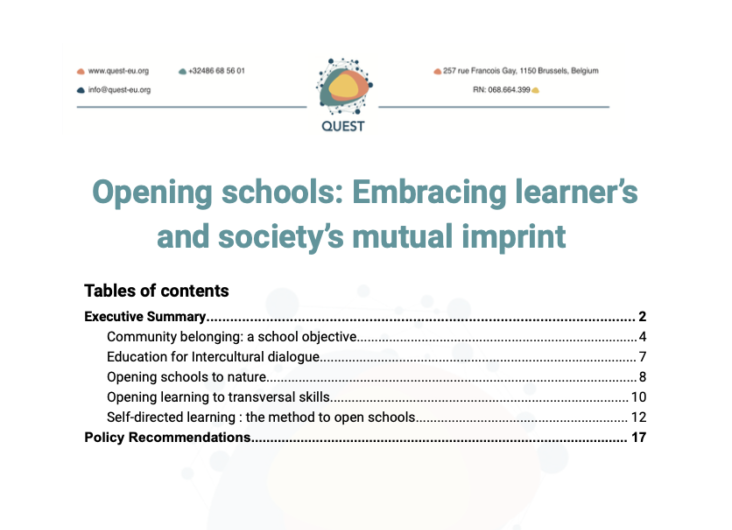
Opening schools: Embracing learner’s and society’s mutual imprint
In a fast-changing society, learners need more than knowledge to fulfil their potential and concretely engage in shaping better futures. However, while students seem to have gained a strong awareness of global issues, they remain reluctant to take action or perceive themselves as responsible actors in finding sustainable solutions. The 2018 PISA survey, for instance, outlined that only about 58% of interviewed students strongly agreed with the idea that they could do something about world issues. Generally, schools are not yet suited to accompany students in being satisfied about their life or later in their jobs , even more so when taking into account gender and broader socio-economic disparities.
Creating a Safe, Inclusive and Supportive Classroom
Sehlim Charles
Biography coming soon.
Young Children’s Voices in Educational Decision-Making: Power and Participation in Disadvantaged Preschool Classrooms
Duygu Yalman Polatlar
Duygu Yalman Polatlar is an Assistant Professor at Fatih Sultan Mehmet Vakıf University, Türkiye. Her research focuses on early childhood education, children’s literature, children’s rights, and children’s participation.
Alperen Avcı
Alperen Avcı is a lecturer at Muş Alparslan University, Türkiye, and a PhD candidate in Preschool Education at Fatih Sultan Mehmet Vakıf University.
Rights-based Participation of Children with Special Educational Needs in Educational Decision-Making
Lenka Mazáková
Lenka Mazakova is a co-founder of the Slobodna skola. She specializes in inclusive educational practices for students with diverse needs and behavioural challenges in democratic school environments.
From Participation to Practice: How Evidence-Based Wellbeing and Equity-Focused Leadership Can Shift Power Towards Children’s Voices in Education
Geetika Goyal
Biography coming soon.
Jayne Carter
Biography coming soon.
Reimagining Educational Research Through Children’s Participation: Insights from Transdisciplinary and Participatory Approaches
Sarah Zerika
Sarah Zerika holds a PhD in Educational Sciences and is a Substitute Research and Teaching Fellow at the University of Geneva’s Centre for Children’s Rights Studies. Her research focuses on children’s rights and participation in education, school climate, transdisciplinary approaches, and the ethics of research involving children.
Johanna Zelck
Johanna Zelck is a research and teaching assistant at the Martin-Luther-University Halle-Wittenberg. Her doctoral research focuses on children’s interpretation and negotiations of the generational order and adultism.
Maude Louviot
Biography coming soon.
From Consultation to Co-Creation: Child Leadership in Practice in Bosnia & Herzegovina and Serbia
Nejira Pasic
Nejira Pašić is the Children’s Rights Project Lead for Southeast Europe at the Global Campus of Human Rights, where she leads children’s rights mainstreaming and programming, including the Child Leadership Team and Youth Advisory Group. She is also a Lecturer at the Sarajevo School of Science and Technology, teaching research methods, public policy and human rights.