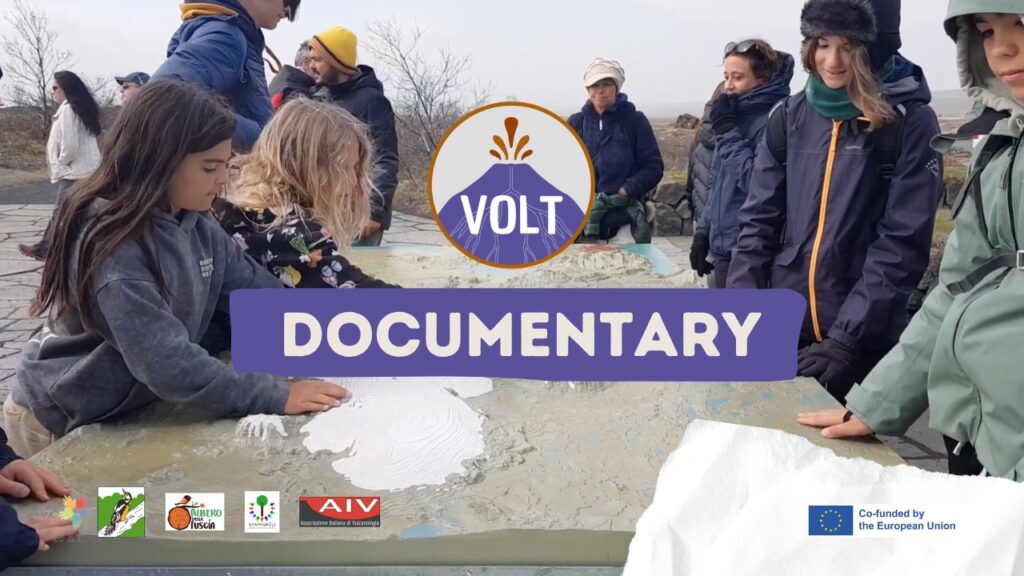
The VOLT documentary follows the learning journey of three schools that came together through the VOLT project. The project supports teachers and students with tools to study local volcanoes from a cross sector perspective, including historical, geographical, geological, and societal dimensions. It also promotes new pedagogical practices such as Inquiry Based Learning.
Filmed across three active volcanic regions, the documentary shows how students from Greece, Iceland, and Italy explored geological phenomena while building connections across countries.
Throughout the VOLT exchanges, students asked questions, investigated volcanic areas, collaborated internationally, and built knowledge together instead of receiving information passively. The experience shows how learning gains meaning when students’ interests guide the process and when lessons connect to real world contexts.
In collaboration with:
Comune di Farnese (Italy)
Albero Della Tuscia (Italy)
Stapaskoli (Iceland)
Associazione Italiana di Vulcanologia (italy)
THESIO DIMOTIKO SCHOLEIO KOS (Greece)
Quality Education in Europe for Sustainable Social Transformation (Belgium)
Funded by the European Union. Views and opinions expressed are however those of the author(s) only and do not necessarily reflect those of the European Union or the European Education and Culture Executive Agency (EACEA). Neither the European Union nor EACEA can be held responsible for them.