
What if school meant traveling, sleeping in forests, and learning through adventure?
In this episode,
Noëmie from Belgium shares her experience in a democratic school and later at the alternative traveling school Lycée Voyageurs, where classes happened on the road.
She describes organizing trips, making decisions in circles, and discovering the balance between freedom and responsibility. From nonviolent
communication to building confidence and maturity, Noëmie explains how learning beyond the classroom shaped her voice and worldview. Tune in for an inspiring story about education, exploration, and finding your place in a community.
Noëmie
My name is Noémie, I’m 16 years old, I’m from Belgium. I was in a democratic school for two years, which was called Nanana, and then I was in an alternative school for a year, which was called the Traveller’s High School. It wasn’t a democratic school, but it looked like one, it’s the same style.
Clémence
Maybe you can explain, Nanana is a democratic school, but was it the Traveller’s High School?
Noëmie
Yes. The Traveller’s High School was a school based on a bus, and we had four days a week. The goal was to learn, but by travelling and having fun, by doing activities, and that’s it, a little different things.
Clémence
Can you explain a typical day at the Traveller’s High School?
Noëmie
At the Traveller’s High School, we had four days of classes, and it was per block for two days, so it started on Monday morning. So we went to the station, the bus came to pick us up, and then we went to another station to pick everyone up. Then we went to a building or to people who think it’s a great idea, or to places with free access.
We had classes to pass our exams at the end of the year, so Monday and Tuesday were reserved for classes. We slept on site or in the bus, it depended. And then on Tuesday evening, we went home.
Thursday was the day of options, so there were two different options, there was culture and nature. I was in nature, so we spent all Thursday in the forest, and then we did activities, like climbing, canoeing, hiking. And then in the evening, we slept in the forest, in a tent, and we made a little fire and all that.
And then on Friday, it was a day where the students could organise an activity, or our principal teacher could organise an activity to learn things.
Stijn
How do you feel about having more freedom to choose what and how you learn?
Noëmie
I really liked having more freedom, because it teaches you to have responsibilities. Since we have more freedom, we have the responsibility to say to ourselves, I’m going to do this, and what will it lead to? I think it makes us more responsible, more mature too, and it makes us think more.
I really felt that I evolved by doing this.
Stijn
How do you choose the activities you do? How does it go? How do you organise?
Noëmie
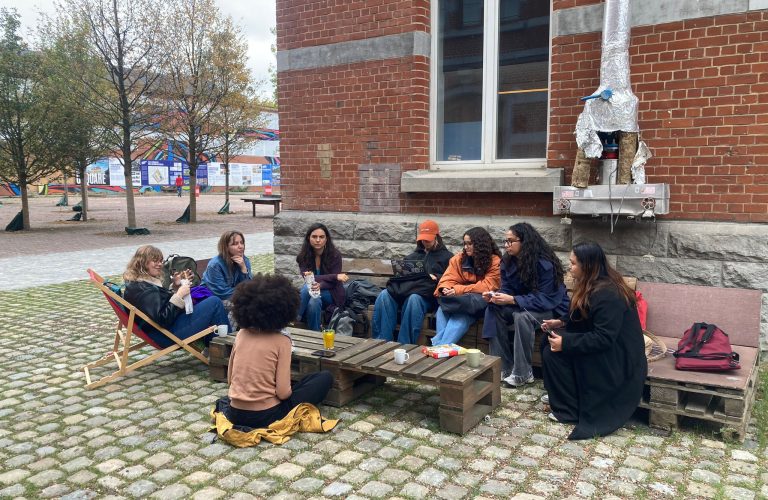
To organise the activities, like the trips, we sometimes made circles so that everyone could express what they felt about the situation, about what we were proposing. For example, for the trips, we looked for the campsites ourselves, and we looked for them according to the price, if it was easy to access, things like that. And for the activities, if someone had a desire, they could propose it and try to realise it themselves or with the help of others.
Clémence
Do you think that the École démocratique has prepared you for the future?
Noëmie
The École démocratique I did and the Lycée Voyageur really made me evolve and I matured a lot to be able to express what we feel, to be able to communicate as a group. So I think that these are things that we don’t learn at school but that will help me a lot later. Yes, we learned French in the morning but I have the impression that it will help me more in the human aspect and the fact of living as a group and being able to listen to each other.
So I think that yes, it will really help me later.
Stijn
How do you think that the École démocratique can help create a more just and fair society?
Noëmie
I think that the Écoles démocratiques can help to create a more just and fair world with the fact that in these schools we learn a lot more about what we really think and so we have more a real opinion to give and have and also we have more the sense of the group and the communication and so the fact that we listen to everyone, we listen to each other and so I think that it can help to make the world more just and fair.
Stijn
In what way your democratic education experience changed your relationship with peers, with adults, with your community?
Noëmie
So the Écoles démocratiques it made me change my way of being with people and all that thanks to the fact that already I learned in the first school where I went the non-violent communication for example with children, to solve conflicts in a soft way where we listen to everyone and so I had never heard of that and so it really made me change I think my way of maybe being with others and to communicate and also the fact that everyone can speak, everyone can express themselves and everyone can say what they think without being judged it feels good and so it opened my mind and new things.
Clémence
What advice would you give to a student in a democratic school for the first time?
Noëmie
I think I would advise them if I had to advise someone who hears about democratic schools for the first time I would advise them if they have the opportunity to test it because it is so different from what we see in everyday society where it is someone who leads and we listen I find it very interesting to see other things and then the fact of being able to say something and also that we are equal even if there are younger people they can also say something so I would really advise them to test and really express themselves and say what they really think like if they do that they express themselves really freely
Ishaan
I have a question would you describe democratic education in a few sentences? What does it mean for you?
Noëmie
If I had to describe democratic education in a few sentences it would be really the fact of all being able to communicate and to all have the freedom to say what they think about a situation and therefore also have the freedom to change things if they want and to be able to propose things even if he is small, even if maybe he is afraid to express himself the youngest, the oldest everyone can say what they think I think that