

What does the new European Agenda mean for education?

In June 2024, the European Council enacted its Strategic Orientations for 2024-2029, which as described in a previous article pave the way for EU legislation for the next 5 years. Presenting three key objectives for the EU (A free and democratic Europe; A strong and secure Europe; A prosperous and competitive Europe), these guidelines fall short […]
A simplified look at the results

From the 6th to the 9th of June 2024, Europeans went to the polls to elect their new representatives. In total, 185 million votes were casted in 27 counties, out of 359 million eligible voters, for the 10th EU Parliament elections since the first elections of 1979. While life doesn’t always keep us close to […]
Why are the EU elections so important?

National legislations, promoting or restricting cutting-edge education, can be highly inspired by laws passed at the EU-level. These laws are shaped by political representatives that we elect every 5 years, and so does the strategic orientation of the EU change. But what does it actually mean? And how does it work? The Institutional Triangle : […]
YGBN Toolkit: Youth at Risk Going back to Nature
About the Project ‘’Youth Going Back to Nature – Engage, Connect, Empower’’ The project ‘’Youth Going Back to Nature – Engage, Connect, Empower’’/YGBN/ is dedicated to young people with fewer opportunities and environmentally sustainable outdoor activities. The aim of the project is to promote and contribute to reaching the EU Youth Goals set by young […]
Community Mapping Tool
The Community Mapping tool is a document that helps connect schools with local communities, by identifying the assets of the school’s neighbourhood, and marking places for potential collaborations.
YOU-CARE: from preoccupation to participation
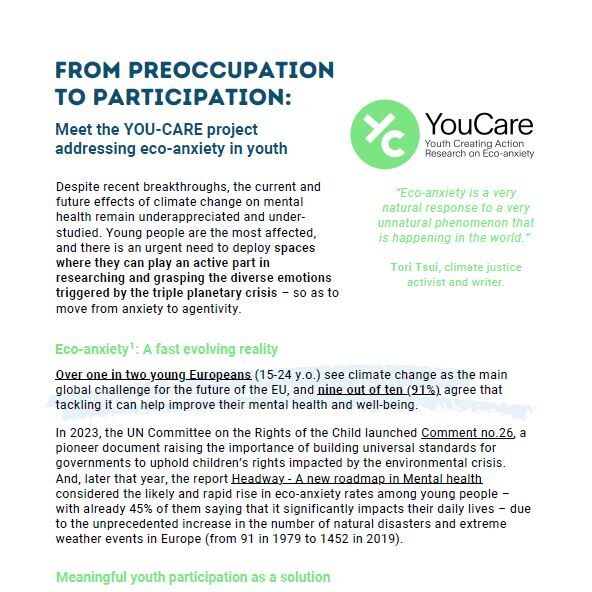
Meet the YOU-CARE project addressing eco-anxiety in youth Despite recent breakthroughs, the current and future effects of climate change on mental health remain underappreciated and under-studied. Young people are the most affected, and there is an urgent need to deploy spaces where they can play an active part in researching and grasping the diverse emotions […]
Climate Pact Ambassadors’ Recommendations for the new EU Agenda 2024-2029
Why this document? Six Belgium Climate Pact Ambassadors have gathered their thoughts and recommendations in this document to inspire the EU Commission’s next 2024-2029 agenda, in the hope to see it reflect citizens’ needs, the reduction of inequalities as well as the preservation of natural resources and planetary boundaries as an utmost priority. To this […]
Facing local environmental challenges through children participation : the key to an inclusive green transition
Children, the new sustainable entrepreneurs Today, recurring news about climate change, natural disasters, biodiversity loss or heightened pollution pose a real risk to the well-being of children as they face greater uncertainty towards their future. To answer this challenge, learners’ active participation in finding solutions can make a difference. Participation indeed develops a feeling of […]
Outside Green Business Collection

The realization of the Collection containing the environmental promotion and sustainability projects carried out by the students had the following phases: 1. Creation of Open Communities of learning 2. Definition of environmental projects 3. Implementation of project-based learning activities in partner schools 4. OUTSIDE Transnational mobility of students in Croatia, Zagreb, September, 2022 5. The […]
YGBN Toolkit: Young women going back to nature

This toolkit is specially designed for specialists who work with the young women at risk. Young women in our society may grapple with a range of complex issues, including mental health challenges, peer pressure, body image, and self-esteem concerns, academic stress, relationship challenges, family dynamics, financial insecurity, substance abuse, gender inequality, experiences of violence and […]