The REGEN2 project (REthinking Gender roles in Education in Nature 2) builds on previous research findings on gender dynamics in nature-based schools for children aged 3-6.
This new phase focuses on children aged 6 to 12, a crucial socialisation phase, and proposes a comparative analysis with traditional schools.
objectives
REGEN 2’s general objective is to better understand and transform gender dynamics and interactions in education by exploring how different contexts and schooling approaches– nature-based and traditional–shape gender roles and social interactions among children aged 6 to 12 […] to foster more inclusive, equitable and sustainable learning environments.
This general objective is supported by the following specific objectives:
S01: Generate Research-based insights on Gender and Education (gather comprehensive data on how educational environments influence gender roles and interactions, to provide a nuanced understanding of the intersection between gender and nature-based learning…)
S02: Develop practical tools for educators to promote gender-inclusive learning (to support teachers as researchers of their own educational contexts
S03: Strengthening Advocacy for Gender-Inclusive Education (engaging European partners, educators, and policymakers to promote gender-inclusive education)
activities
RESEARCH Participatory observation by educators in nature-based schools and urban playgrounds, surveys, focus-groups / interviews.
ACTION : co-creation of practical resources, including a digital app, a card deck for inclusive outdoor learning, and
a set of professional online training modules.
DISSEMINATION : including through a fanzine and a Final Conference.
The following tangible results will be created:
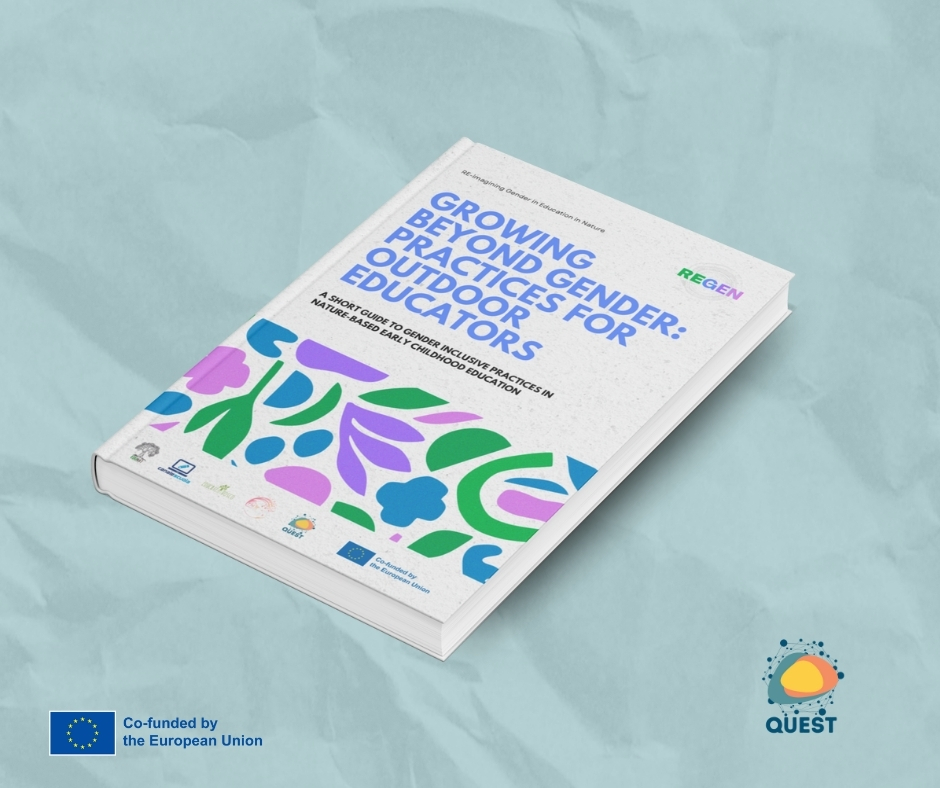
A fanzine on gender dynamics in forest schools
A digital app
A card deck for inclusive outdoor learning
A training platform.
A hybrid Final Conference to share results and policy recommendations widely,
including with decision-makers
duration
01/09/2025 – 31/08/2027 (24 months)
target groups
Children aged 6-12
Educators
Policymakers
call
This project is under the KA220-SCH – Cooperation partnerships in school education
contact
dominika@quest-eu.org
sarapatricia@quest-eu.org
partnerships
KWEEBUS (Belgium)
Edunat Cooperativa (Spain)
La navel nel bosco (Italy)
la maison rouge (Morocco)
QUEST (Belgium)
APS Icaro I Care (italy)
Funded by the European Union. Views and opinions expressed are however those of the author(s) only and do not necessarily reflect those of the European Union or the European Education and Culture Executive Agency (EACEA). Neither the European Union nor EACEA can be held responsible for them.
Related publications
More projects
DARE
January 2026 - December 2026
Research – Act – Impact (RAI)
February 2026 - September 2026
SWELL
December 2025 - November 2028
YPARC
December 2025 - November 2027
Inclusive Voices
November 2025 - June 2026
YOUDEX
March 2025 - May 2026
DECUS
Dec 2024 - Sept 2027
VOLT
Sept 2024 - Feb 2026
Cala Wioska School
Cala Wioska School
Biography coming soon.
Creating a Safe, Inclusive and Supportive Classroom
Sehlim Charles
Biography coming soon.
Young Children’s Voices in Educational Decision-Making: Power and Participation in Disadvantaged Preschool Classrooms
Duygu Yalman Polatlar
Duygu Yalman Polatlar is an Assistant Professor at Fatih Sultan Mehmet Vakıf University, Türkiye. Her research focuses on early childhood education, children’s literature, children’s rights, and children’s participation.
Alperen Avcı
Alperen Avcı is a lecturer at Muş Alparslan University, Türkiye, and a PhD candidate in Preschool Education at Fatih Sultan Mehmet Vakıf University.
Rights-based Participation of Children with Special Educational Needs in Educational Decision-Making
Lenka Mazáková
Lenka Mazakova is a co-founder of the Slobodna skola. She specializes in inclusive educational practices for students with diverse needs and behavioural challenges in democratic school environments.
From Participation to Practice: How Evidence-Based Wellbeing and Equity-Focused Leadership Can Shift Power Towards Children’s Voices in Education
Geetika Goyal
Biography coming soon.
Jayne Carter
Biography coming soon.
Reimagining Educational Research Through Children’s Participation: Insights from Transdisciplinary and Participatory Approaches
Sarah Zerika
Sarah Zerika holds a PhD in Educational Sciences and is a Substitute Research and Teaching Fellow at the University of Geneva’s Centre for Children’s Rights Studies. Her research focuses on children’s rights and participation in education, school climate, transdisciplinary approaches, and the ethics of research involving children.
Johanna Zelck
Johanna Zelck is a research and teaching assistant at the Martin-Luther-University Halle-Wittenberg. Her doctoral research focuses on children’s interpretation and negotiations of the generational order and adultism.
Maude Louviot
Biography coming soon.
From Consultation to Co-Creation: Child Leadership in Practice in Bosnia & Herzegovina and Serbia
Nejira Pasic
Nejira Pašić is the Children’s Rights Project Lead for Southeast Europe at the Global Campus of Human Rights, where she leads children’s rights mainstreaming and programming, including the Child Leadership Team and Youth Advisory Group. She is also a Lecturer at the Sarajevo School of Science and Technology, teaching research methods, public policy and human rights.